How to tell whether your website is generating leads — or just traffic.
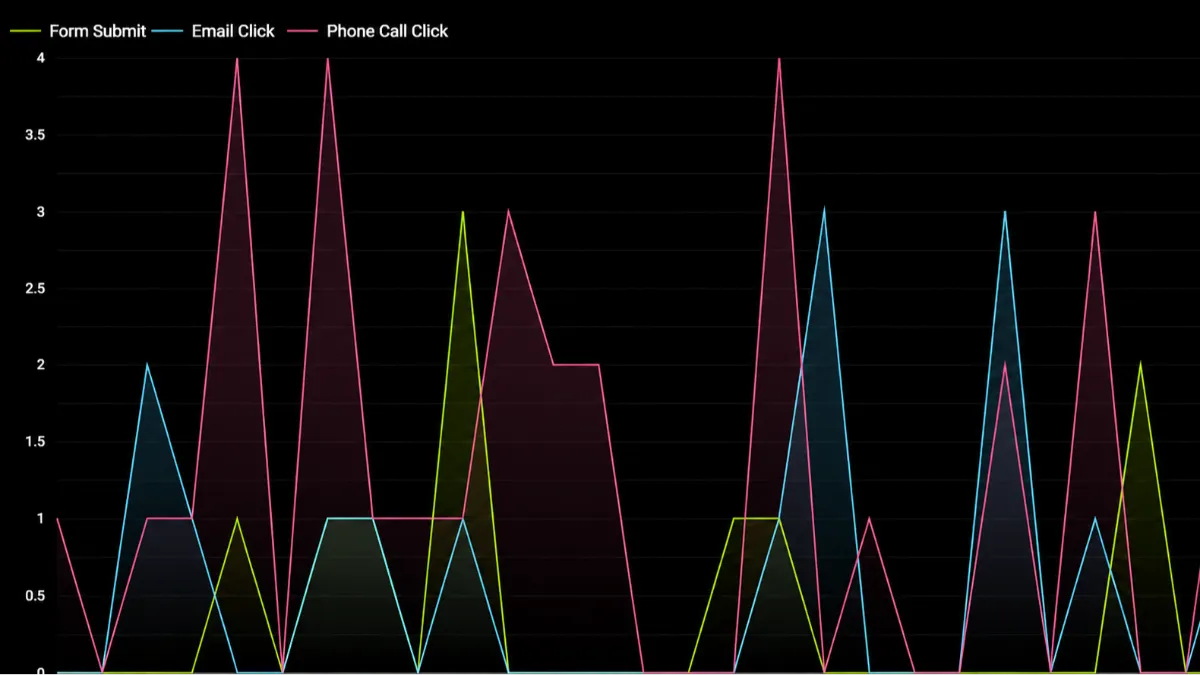
The report looks great and the phone doesn’t ring
This is the most common situation we walk into. Traffic is up. The monthly report is full of green arrows. Somebody is pleased about a ranking. And the broker’s actual experience of the last quarter is that nothing changed.
Both things are usually true at once. The traffic really did go up, and it really did not turn into business. That is not a contradiction — it is what happens when the numbers being reported are not the numbers that pay anyone.
Leading indicators are not results
Impressions, rankings, clicks, sessions, time on page, and bounce rate are all leading indicators. They tell you whether people are finding you and whether they stayed long enough to matter. They are worth watching, because they move first and they tell you early when something is working.
But they are upstream of the business. The numbers closer to actual value look different: qualified leads, lead quality, how many became conversations, how many became appointments, how many became signed agreements, and what those cost you to get.
The gap between the two lists is where most real estate marketing quietly fails. A site can double its traffic and produce the same number of appointments, and every dashboard will still be green.
The test is simple: can you name the last five leads your website produced, and say what happened to each one? If you can’t, you are measuring visibility, not performance.
Four questions that separate traffic from pipeline
1. Do you know where each lead came from?
Not “organic search” — which page, which search, which campaign. If every inquiry lands in your inbox looking identical, you cannot tell which parts of your site are earning business and which are decoration. You end up guessing about the biggest budget decisions you make.
2. Do you know how long it takes you to respond?
This is usually the largest single leak, and it has nothing to do with the website. A lead that sits for hours is competing with whoever answered first. If you don’t know your median response time, you don’t know your conversion rate — you know your response time’s conversion rate.
3. Do you know how many leads became appointments?
Lead count on its own is a vanity number, because it treats a serious seller and a mistyped email as the same event. Appointments are the first metric that reliably correlates with revenue. If nothing in your system records the step from inquiry to conversation, the entire back half of your funnel is invisible.
4. Can you tell a good lead from a bad one, in the data?
More leads is not automatically better. A form that generates fifty unqualified inquiries a month is worse than one that generates eight real ones, because it costs you the same attention and produces less. Volume is only meaningful next to quality.
If you answered no to two or more of these, the constraint is almost certainly not traffic.
Where the leak usually is
In rough order of how often it turns out to be the actual problem:
Response time. Covered above, and consistently the cheapest thing to fix relative to what it returns. No website change competes with answering faster.
The form asks for too much. Every additional required field costs completions. Real estate forms tend to accumulate fields nobody uses — a full address, a budget dropdown, a “how did you hear about us” — each one shaving off people who would have converted.
The mobile experience of the property search. Most buyers are on a phone. If the search is slow or awkward to use, they leave before they ever reach a form, and no amount of traffic fixes that.
There’s no obvious next step. A page can be well-written and still not tell anyone what to do. If a visitor who is genuinely interested has to hunt for how to contact you, most of them won’t.
Nothing is tracked, so nothing can be diagnosed. If lead source, response time, and outcome are not recorded anywhere, every conversation about performance is opinion. This is worth fixing before anything else, because it’s what makes the other four knowable.
Notice that four of the five are conversion and operations problems, not visibility problems. Buying more traffic to solve them makes the leak more expensive, not smaller.
What to actually watch
A short list beats a comprehensive dashboard nobody opens:
- Leads per month, by source and by landing page. Not sessions.
- Median response time. One number, tracked honestly.
- Lead-to-appointment rate. The first number that means anything.
- Appointments per month. The one to hold everything else accountable to.
- Cost per appointment, if you’re spending on ads.
Keep rankings and impressions on the report — they’re genuine early signals, and they tell you when the top of the funnel is moving before the bottom does. Just stop treating them as the outcome. They’re the weather, not the harvest.
The honest version of measurement
Two habits are worth more than any tool.
Don’t confuse correlation with cause. Traffic went up and closings went up in the same quarter does not mean one produced the other. Spring happened. A referral happened. Something else happened. Being disciplined about what your evidence actually proves is what makes the claims you can make worth believing — it’s why every figure on our Delta Realty case study carries its own measurement window instead of one blended headline.
Measure the thing you’d act on. If a number going up or down wouldn’t change a single decision you make, it doesn’t need to be on the report.
If you’re not sure which of these your site is failing, that’s precisely what a Lead System Audit looks at — your website, property search, lead capture, routing, and search visibility together, with a plain answer about which one is actually costing you business.